Posts

CHARM TOOL

Image
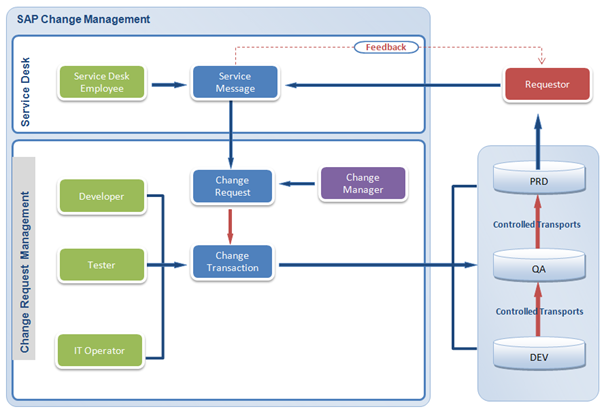
SAP ChaRM (Change Request Management) SAP ChaRM  is SAP Solution Manager based tool which provides tracking and documentation of all change requests and transports for business solution development in an organization. A typical  Change Request Process  is initiated by a business user via service help desk. Help desk assigns Change Request (CR) to respective manager where manager validates request to take further action. Manager validates if request is valid. Manager assures, change request is approved by business logically and financially. Manager assigns CR to developer and tracks all changes from DEV to PRD system. Standard Change Request Process for Development / Enhancements New Requirement / Correction request by the Business User This requirement is validated by the Change Manager The Change Manager provides information on effort, duration and cost for this CR After approval of the CR, the CR is accepted by the SAP Development Te...

MESSAGE PACKAGING

MESSAGE PACKAGING We  can improve the performance of message processing in SAP NetWeaver Process Integration (PI) by grouping together asynchronous messages in packages and then processing each message package in one LUW. We  configure how packages are created in the sender system and in the central Integration Engine. Packages can be received and saved in the receiver system. They are then processed as individual messages. Sender adapters handle message packages in different ways. ●        The Advanced Adapter Engine can receive packages but not create them. ●        The Business Process Engine (BPE) can process packages ●        The IDoc adapter sends all messages that have the same interface to the Integration       Server in one RFC call. It can send IDoc message packages to an IDoc receiver. ●        The plain H...

EDI BASICS

Image
EDI is a standardized format which companies use to exchange information electronically rather than with paper & the business entities who are involved are called as Trading Partners. Before EDI, a typical Order-to-Cash scenario used to be like below - Now, this is a typical EDI flow. Major advantages of EDI were speed- faster data transfer, reduction in human failure. Major B2B transactions used are RFQ- Request For Quotation, PO- Purchase Order, Sales order, Advance shipping notice, Invoice, etc. Here is an example of O2C/P2P cycle -  EDI STANDARDS -  These standards are formats for the EDI documents. It specifies where what information goes in an EDI document.  EDIFACT, ANSIX12 are some of the EDI standards most commonly used. Below is a sample ANSI X12 File - ST/SE ( Transaction Sets ) - It is the smallest meaningful set of information exchanged by trading partners such as a purchase order or...

Proxy Configuration between PO & ECC

Image
A) First, we need to create a Logical System in ECC which will point to PO system. Go to tcode - BD54   & create a logical system. B) Then, depending on whether your system is single/dual stack, create a RFC destination from SM59  which will point to PO system. If its a Single stack - create Type G connection            Dual stack - create Type H connection while creating we should follow a standard Path Prefix for both Type H & Type G connection Connection Test should result in Status 200 ex: Type H Target Host : Hostname of PO system Path Prefix : /sap/xi/engine/?type=entry Type G Target Host : Hostname of PO system Path Prefix :   /XISOAPAdapter/MessageServlet?ximessage=true C) Go to SXMB_ADM - Configuration -  Select Category as Runtime  select parameter -  IS_URL Value =  dest://<your_rfc_destination> D) We will create o...